About Me
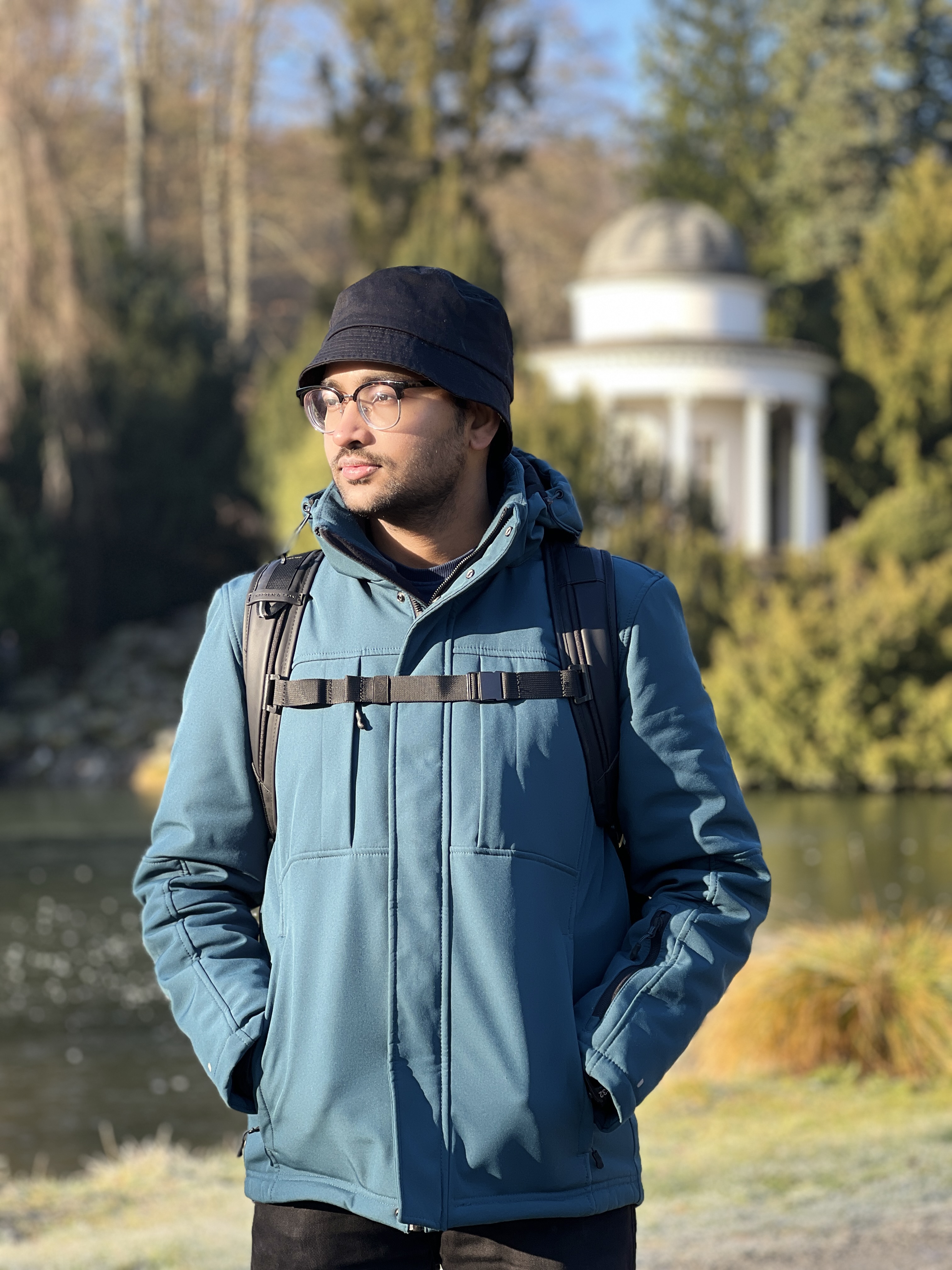
Madhva Fakare
I'm a Master's student in Physics at the University of Münster. My thesis sits at the intersection of experimental particle physics and machine learning — building a pipeline to separate electrons from pions using the Transition Radiation Detector inside ALICE at CERN.
What I Work On
My thesis focuses on electron-pion separation using the Transition Radiation Detector (TRD) inside ALICE. ALICE is designed to study the quark-gluon plasma — a state of matter that existed microseconds after the Big Bang — by colliding lead nuclei at nearly the speed of light.
The TRD distinguishes particle types based on transition radiation emitted passing through alternating materials. My job is to build a machine learning pipeline that uses these signals to separate electrons from pions as accurately as possible.
Day-to-Day
- Writing analysis code in C++ within O2Physics on CERN's lxplus servers
- Building ROOT macros to explore TRD detector signals across time bins (Q0, Q1, Q2)
- Training Boosted Decision Trees on real Run 3 data for particle identification
- Navigating AO2D files and linking track parameters to Monte Carlo truth labels
- Using CVMFS to access pre-compiled O2Physics without 24-hour local builds
Full analysis on GitHub: alice-trd-analysis
Background
I completed my undergraduate Physics studies in India before coming to Münster. The jump to real experimental data has been steep — ROOT, a million-line codebase, actual LHC collision data. But the signals I'm analysing came from real lead-lead collisions at 5.5 TeV, briefly recreating the state of the universe a few microseconds after the Big Bang. That's hard to get tired of.
Beyond Physics
I'm interested in how AI tools can speed up scientific workflows — there's a Physics AI Assistant built into this site, pre-loaded with my project context. I also write occasional blog posts about things I figured out the hard way in ROOT or O2Physics.
Get in Touch
Working on ALICE, particle ID, or ROOT/O2Physics? Happy to talk.